January 31, 2005

Signs of Hope

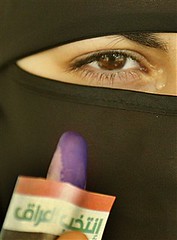
The news of wider-than-expected voter turnout in Iraq on Sunday is the first glimmer of hope I've seen about the Iraq situation in a long time. I think the world was expecting horrific violence and low voter turnout, but the opposite happened. Yes, there were election-related attacks by insurgents. But the Iraqi electorate, through sheer force of popular will, seemed to rise as one to take control of the future of their country.

Through their collective acts of courage to make it to the polling centers to vote, they highlighted the following points:

1. They dispelled the notion that Arabs are somehow disinterested in the notion of democracy. One of the more compelling stories I witnessed was shown on NBC News Sunday night. They showed an 80 year old Iraqi man, supported by two family members, struggling to walk over a mile to his polling place just to cast a ballot. I know people here in the US who won't vote because it rains. That story of the old Iraqi man just reinforced my belief that those in the United States who don't exercise their right to vote are dishonoring the thousands of American soldiers through history who have died to defend that right, as well as those who have died bringing that right to the Iraqis.

2. They disavowed the terrorist tactics of the insurgents. It seemed to take something like a framework of a national election, where many voices could speak out "as one," for Iraqis to voice their opinions on the insurgents. It was too dangerous to speak out individually, for they could become targets of the insurrection. Also, to have spoken out individually against the insurgents would have risked labeling them as US sympathizers or collaborators. But in voting in a national election, they could display their nationalistic pride whilst at the same time sending a message to the insurgents: "We do not approve of your tactics."

That being said, this is but the first step. Many other things have to happen in order to make sure that this first, positive step taken by the Iraqi people is not a wasted opportunity for real democratic progress:

1. The Sunni question. At the time of this writing, it is still unclear to what extent the Sunnis participated in this election. Regardless of the actual turnout figure for Sunnis, it is vital that efforts be taken to include Sunnis in the next phase of the rebuilding of Iraq. It would be disastrous if the Shiites, who are widely expected to gain power through the results of these elections, allowed the Sunnis to feel disenfranchised and gave them any sort of excuse to disregard these elections as invalid. Diplomacy is vital here, and I hope that the newly elected government can make its way through the Sunni Question. US participation can help, but I feel that the UN must take the lead here. US participation will just give the Sunnis another excuse to claim the election is invalid.

2. Infrastructure improvements must accelerate. Despite the enthusiasm shown in voting, there must be tangible improvements in the day-to-day lives of Iraqis if democracy is to take root. Participation in democracy in an of itself is meaningless unless the Iraqi people feel that it has made a difference in their lives. The US must put its money where its mouth is and spend the capital necessary to improve the infrastructure that has been destroyed in the war. Yes, the insurgents are actively sabotaging that effort, but if no effort is shown to be made what motivation will Iraqis have to rise up and defend their country? If an Iraqi hasn't had running water since the US invasion, he's going to wait until the US rebuilds his water supply.

3. There must be progress made in the Palestinian-Israeli conflict. US policy in this area is at the heart of many Muslims' antagonism towards the US. The passing of Yasser Arafat, whom President George W. Bush famously refused to work with, and the passing of power to Mahmoud Abbas and his more constructive and progressive attitudes, have created conditions where the Palestinian-Israeli peace process can finally make some significant strides. Up until now the US has done virtually nothing to promote the peace process. I hope that the Bush administration can finally see the enormous opportunities that have presented themselves in that region, and move strongly and decisively towards helping both sides achieve peace in the region.

This is as important, if not more so, to the fight against terrorism than the nascent democratic process now unfolding in Iraq. Just because Iraqis have participated in free elections does not mean that terrorism will decrease. Local insurgent activity in Iraq will most likely increase as Sunnis try to de-legitimize the election. And the underlying realities of war mean that a new pool of young men and women with anti-US leanings are ready to be recruited into the terrorism network. Even if democracy successfully takes hold in Iraq -- and it is still an "if" -- it will take a generation or more for its effects to make a meaningful difference in the attitudes that promote terrorism. I believe that progress in the Palestinian-Israeli issue will have more of an effect in the shorter term.

January 20, 2005

The Face of War

A shooting after nightfall "...children started emerging, crying, their faces mottled with blood in long streaks."

This is the face of war: a 5 year old girl's face splattered with the blood of her parents as she cries out in terror.

I do not blame the soldiers. They are put into an impossible situation, trying to secure their security in an increasingly hostile and unstable environment. I blame those in power who put those soldiers, and that family, and that 5 year old girl, in that situation.

This is why millions marched against the war when the Bush administration started making noise about invading Iraq, and why the majority of the American population now no longer thinks the war is worth the cost.

I do not doubt that there are good things going on in Iraq that are not being publicized. But one incident such as this -- even if it was an accident -- undoes any goodwill towards the US that may have been built up.

Take a look at the little boy watching his sister cry. Let me tell you: I think there's more of a chance that he'll join the jihadists than become a peaceful supporter of the US as this incident becomes seared into his young memory.

Having abandoned the search for WMD in Iraq because -- surprise! -- there are none, Bush now hangs his Iraq policy hat on "bringing democracy, freedom, and liberty to the people of Iraq." All of you war supporters out there, I ask you: If, during the hunt for Osama bin Laden in Afghanistan, Bush came out and said that the US was going pull troops out of Afghanistan to invade and bring democracy to Iraq, what would your response have been?

Yes, I know that bringing democracy to the Middle East is a cornerstone to this country's effort of stopping terrorism against the US. But look at the picture of the young girl. Do you think we're succeeding in capturing hearts and minds?

December 13, 2004

How to find cheap gas prices in your city

GasBuddy.com - Find cheap gas prices in your city "170 gas price information web sites that help consumers find low gasoline prices."

I just found out about this site, and I'm intrigued enough to try it out for a while. It looks to be a grass-roots, non-profit effort to disseminate gas prices on a timely basis.

The first site that had this functionality was MSN, believe it or not. But they never had any information about my area, and as far as I can tell, they still don't have much of a database.

GasBuddy on the other hand has prices listed for 7 gas stations in my hometown alone. The gasbuddy.com site itself seems to just be a gateway and jumping off point for the 170 individual sites (texasgasprices.com, bostongasprices.com, etc.) that actually list the prices in their respective areas.

I'll be keeping an eye out to see if the prices are up to date. As a grass-roots effort with what seems to be a vibrant community, I would assume that they will be.

December 08, 2004

Defense Department Admits Failure of Policies in Iraq

Report of the "Defense Science Board Task Force" on Strategic Communication"American efforts have achieved the opposite of what they intended. American direct intervention in the Muslim World has paradoxically elevated the stature of and support for radical Islamists." -- Department of Defense, "Defense Science Board Report on Strategic Communication", October 2004, pg. 40

It's nice to see the administration finally admit what millions of American citizens and citizens of the world knew back before the Iraq invasion: That the invasion would do more harm than good.

I know I wanted to steer clear of politics, and I said so in an earlier post. I did so mainly because I believe each person should vote their own conscience free of proselytizing and the other media hype that surrounds presidential elections. Now that the election is over, I thought I'd start posting about the reasons why I did not vote Republican for the first time in my life.

And this is the first one. The report I linked to is not a left-leaning blog, not the product of the so-called liberal media, nor of a liberal think tank. It comes straight from the Defense Department. I don't think you can get any clearer than the two sentences at the top of page 40 (page 48 of the PDF file) (and I paraphrase): "Our efforts have failed. The invasion has actually given the terrorists more support in the Muslim World."

It doesn't take a genius to figure out that sending troops into a Muslim country without provocation is not going to win the hearts and minds of the Muslim world. And the argument that possible Weapons of Mass Destruction mandated our preemptive action has been shown to be false. Our military personnel on the ground in Iraq, with task forces whose sole purpose was to find these WMD, has still not been able to find any evidence of WMD for over 18 months.

I've heard the arguments: "Those WMD may still be there, we don't know for sure" and "I didn't see the intelligence, but it must have been persuasive enough to justify the invasion." At some point, you have to call a spade a spade.
1. During the Afghanistan campaign to oust the Taliban (which I fully support), there was initial confusion as to why Iraq was targetted.
2. When so-called "evidence" was presented for the case to go to war, millions in this country and around the world still were not convinced.
3. When we were finally in a position to definitively determine whether there was any evidence WMD, whether or not they were removed, no evidence was to be found.

This sequence of events has removed any moral authority the US had in waging war. You can say "but Saddam Hussein was a brutal dictator. The world is better without him." Yes, you can say that, but that's not what this administration advanced as the justification to go to war. The justification was the possibility of WMD. The fact that Saddam was a brutal dictator was a convenience, not the main reason. Colin Powell did not go in front of the United Nations with evidence pointing to Saddam's brutality. He showed evidence that purported the existence of WMD. Now that none have been found, how can you not assume that the rest of the world thinks the war lacks moral authority?

It looks more and more like the evidence was "manipulated" to support the foregone conclusion of the administration that Iraq needed to be invaded. And once people start thinking that, you've lost the war for hearts and minds, which -- in case you've forgotten -- is the real war on terror.

December 01, 2004

Pediatric Medicine of Wallingford

Pediatric Medicine of Wallingford
Here's a plug for a friend's pediatric practice in Wallingford, CT. Hopefully, this will cause Google to crawl the page and include it in its index. Hopefully, it'll also help to increase its PageRank.

Just so you know, the practice is called Pediatric Medicine of Wallingford in Wallingford, CT, which is located in Central Connecticut. They are a group of pediatricians offering services in vaccination, hearing screening, vision screening, physicals.

Yes, you webheads are probably seeing that I'm including many of the site's META keywords to try and increase relevancy ranking.

They also have pages that describe their staff, location, as well as a page of Frequently Asked Questions.